
You do not need a large backyard to grow your own fruit.
A sunny balcony, terrace or a small corner beside your house can be enough for many fruit plants — provided you choose the right variety, give the roots enough space and understand what the plant actually needs.
For Indian gardeners, this is particularly exciting because our warm climate allows us to grow everything from mango and guava to pomegranate, lemon, mandarin and even some more unusual tropical fruits.
The biggest mistake is assuming that every fruit tree must eventually become a huge tree.
That isn’t always true.
Many grafted, compact and carefully maintained fruit plants can be grown successfully in containers for years. Some will eventually need a larger pot, while others can remain surprisingly manageable with pruning.
If you’re planning a balcony fruit garden, here are 10 of the best fruit plants to grow in pots in India, along with practical care advice for each one.
You can also browse Bonotol’s complete collection of fruit plants available online in India, including common favourites as well as unusual grafted and exotic varieties.
1. Guava
Guava is one of the easiest fruit plants for Indian home gardeners.
It loves warm weather, responds well to pruning and can adapt quite comfortably to container growing. That makes it a very good starting point if this is your first attempt at growing a fruit tree on a balcony or terrace.
Why guava works well in pots
Guava develops vigorously, but regular pruning can keep the canopy compact. Grafted or established nursery plants are generally more practical for container gardeners than starting from seed when your goal is fruit production.
Pot size
Start with a medium container for a young plant and gradually move it into a larger pot as the root system develops.
For a mature container-grown guava, a pot around 18–24 inches wide is much more comfortable than keeping it permanently in a small nursery pot.
Sunlight
Give guava approximately 6–8 hours of direct sunlight whenever possible.
More sunlight generally means stronger growth and better flowering potential.
Watering
Water deeply and then allow the upper layer of soil to begin drying before watering again.
Avoid keeping the roots continuously soggy.
Good varieties to explore
Instead of limiting yourself to one ordinary guava, collectors can explore varieties such as Allahabad Safeda, Baruipur Guava, Black Diamond and other selections.
If guava interests you, check the latest varieties in Bonotol’s fruit plant collection.
2. Mango
Yes — you can grow a mango plant in a large pot.
The key is choosing the right plant and understanding that container-grown mango trees need pruning. An unrestricted mango tree planted in the ground can become enormous. A grafted mango maintained as a container specimen is a completely different proposition.
Choose grafted mango plants
For home gardeners interested in fruit, grafted plants are generally preferable to mango seedlings because they retain the characteristics of the selected variety and are easier to manage for planned cultivation.
Pot size
A young grafted mango can begin in a smaller container, but eventually give it a sturdy pot approximately 20–24 inches or larger, depending on the variety and age.
Good drainage is essential.
Sunlight
Mango loves sun.
Aim for at least 6–8 hours of direct sunlight, with an open terrace often being better than a heavily shaded balcony.
Watering
Water thoroughly, but never allow the potting medium to remain constantly wet.
During very hot Indian summers, container plants may need watering more frequently because pots dry considerably faster than garden soil.
Pruning matters
Once the plant establishes itself, selective pruning helps encourage branching and keeps the tree at a manageable height.
This is especially important on balconies and terraces.
Go beyond the usual mango varieties
This is where fruit gardening becomes genuinely interesting.
Along with familiar mango varieties, Bonotol carries more unusual selections including Naam Dokmai, Bari 4 and Kartimon.
Naam Dokmai, in particular, is an exciting choice for gardeners who enjoy collecting distinctive mango varieties rather than planting only common commercial cultivars.
Browse the current mango and fruit plants at Bonotol to see which varieties are presently available.
3. Pomegranate (Anar)
Pomegranate is almost made for sunny terrace gardening.
The plant tolerates heat, enjoys strong sunlight and can be trained into an attractive compact shrub or small tree.
It also has beautiful flowers, so even before fruiting it earns its place in the garden.
Pot requirements
Use a container approximately 16–20 inches or larger for a reasonably mature plant.
The pot must drain freely.
Sunlight
Pomegranates prefer abundant sunshine.
Give the plant 6–8 hours of direct sun for healthy growth and good flowering.
Watering
Water when the upper soil begins drying.
One of the biggest problems with container-grown pomegranate is inconsistent watering — alternating between extremely dry soil and excessive water can stress the plant.
Try to keep moisture reasonably consistent without waterlogging it.
Feeding
During active growth, use organic compost along with a balanced fertilizer according to the product’s recommended dosage.
Once flowering begins, avoid endlessly pushing soft leafy growth with excessive nitrogen.
4. Lemon
If you could grow only one fruit plant on an Indian balcony, lemon would be near the top of the list.
A healthy lemon plant is useful, attractive and reasonably easy to maintain in a container.
And unlike a giant shade tree, it can be pruned into a manageable shape.
Pot size
A 16–20 inch pot is a useful target for an established plant, although large specimens will appreciate more root space.
Sunlight
Give lemon approximately 6–8 hours of direct sunlight.
A plant kept permanently in deep shade may survive, but flowering and fruiting can suffer.
Soil
Lemon hates stagnant water.
Use a loose, fertile and well-draining potting medium containing organic matter.
Watering
Check the soil rather than watering automatically every day.
Water thoroughly when needed and allow excess water to escape through the drainage holes.
A common lemon problem
Citrus plants sometimes produce yellow leaves because of watering problems, nutrient deficiencies or unsuitable root conditions.
Don’t immediately add more fertilizer whenever you see yellowing. First check drainage, watering and the overall health of the roots.
5. Mandarin & Orange
Imagine walking onto your terrace and picking a fresh mandarin.
Citrus trees are excellent candidates for large containers when they receive enough sunlight and drainage.
In India, gardeners can experiment with much more than the most common local orange.
Container size
Use a progressively larger pot as the plant develops.
Established citrus appreciates a substantial container, often 18–24 inches or more, rather than a shallow decorative planter.
Light
Full sun is important.
Choose the brightest section of your balcony or terrace.
Feeding
Container citrus consumes nutrients over time because watering gradually washes nutrients from the pot.
Organic compost plus an appropriate citrus or balanced feeding programme can help maintain healthy foliage and flowering.
Interesting varieties
Gardeners who enjoy unusual fruit plants can look beyond standard citrus and explore varieties such as Darjeeling Komola and different mandarin selections.
Bonotol’s fruit collection also includes an Orange & Mandarin section, making it easier to compare available plants in one place.
Explore fruit plants online at Bonotol →
6. Water Apple / Jamrul
Jamrul deserves much more attention from Indian terrace gardeners.
Also known as water apple or wax apple, it is a tropical fruit tree that loves warm conditions and can respond very well to pruning.
Some varieties produce beautiful red, pink or green fruits that almost look ornamental.
Can Jamrul grow in a pot?
Yes, particularly while young and when maintained through pruning.
However, this is not a plant to keep forever in a tiny 8-inch container.
Give the roots room to grow.
Sunlight
Provide plenty of direct sunlight.
Water
Jamrul prefers moisture more than drought-loving fruit plants, but the container still needs proper drainage.
Never confuse “likes moisture” with “likes standing water”.
Why collectors love Jamrul
Different cultivars can vary noticeably in fruit shape, colour and flavour.
Varieties such as Bali Chamba can turn a simple terrace fruit collection into something considerably more interesting than a group of standard nursery plants.
7. Litchi
Litchi isn’t usually the first plant people imagine growing on a balcony, and it is certainly not as easy as lemon or guava.
But a young or compact litchi can be grown in a substantial container, especially by gardeners prepared to give it a little more attention.
The challenge
Litchi appreciates moisture and dislikes severe root drying, yet the roots also need aeration.
Container temperature can rise quickly in direct summer heat, so protecting the root zone from extreme heating can help.
Potting medium
Use a fertile, well-draining medium that can hold some moisture without turning into heavy mud.
Sunlight
Good light is necessary, but newly established or recently transported plants should be acclimatised gradually rather than immediately exposed to extreme afternoon summer sun.
For the collector
Rare selections such as Chakapat Litchi are precisely the sort of fruit plants that make a home collection different from what you see in every neighbourhood nursery.
If you’re building a collection rather than simply buying the most common fruit saplings, keep an eye on Bonotol’s rare and grafted fruit plant collection.
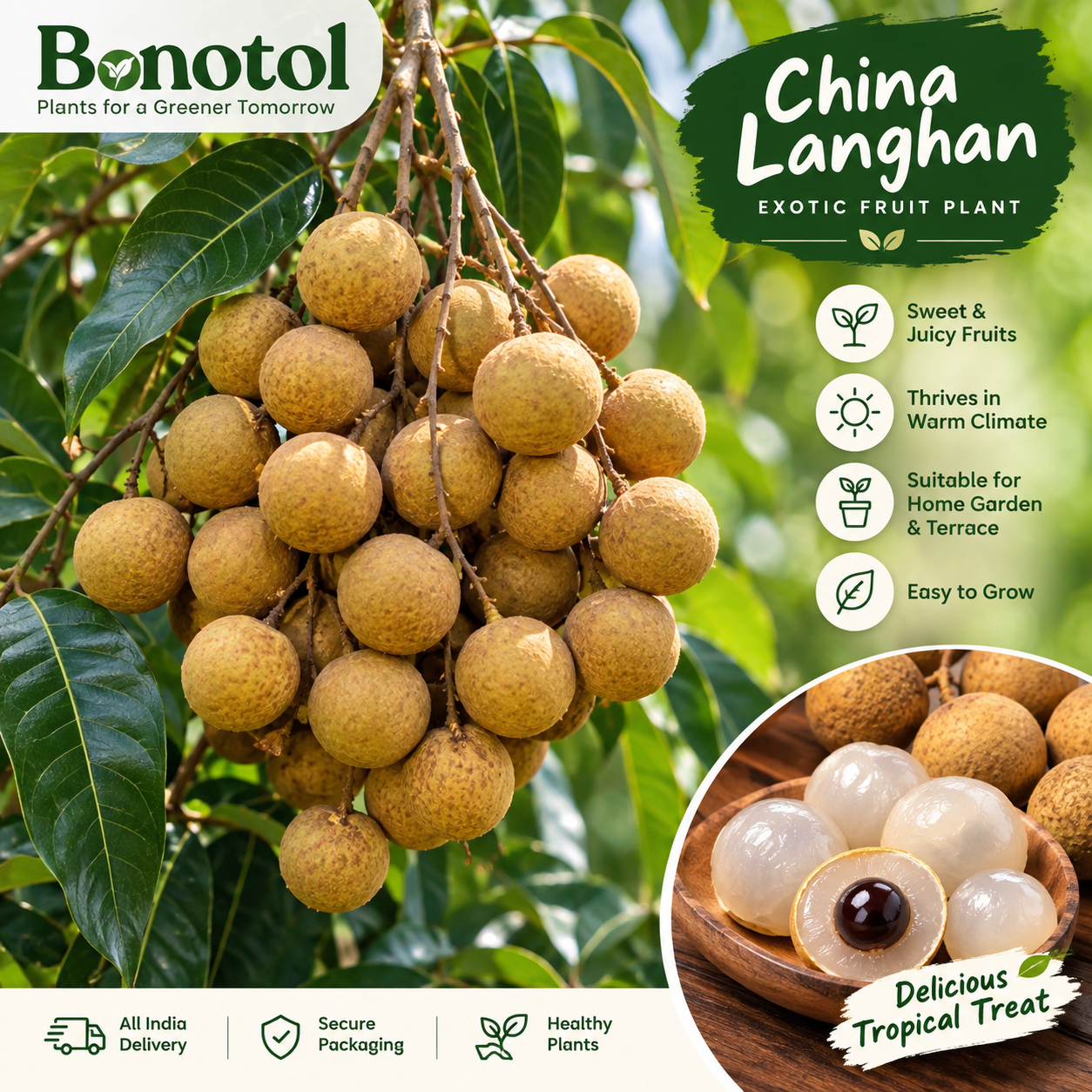
8. Longan / Langhan
Longan is still unfamiliar to many Indian home gardeners, which makes it one of the most interesting fruits on this list.
It is related to litchi and produces clusters of small, round fruits with translucent flesh.
Growing Longan in containers
Young plants can be maintained in large pots, although vigorous specimens will ultimately appreciate generous root space.
Regular pruning is important if the plant is intended to remain compact.
Sunlight
Longan enjoys bright conditions and good sunlight once established.
Water
Keep moisture reasonably consistent during active growth without leaving the roots waterlogged.
Why grow it?
If mango, guava and lemon are already in your garden, Longan gives you something genuinely different.
It is particularly appealing to collectors looking for tropical fruit species that are less commonly seen in ordinary Indian home gardens.
9. Grapes
Grapes are different from most plants on this list because they’re vines rather than trees.
That actually makes them fantastic for terraces.
Instead of consuming valuable floor space with a large canopy, a grapevine can be trained upward onto a trellis, railing or pergola.
Container
Use a large pot with good depth and excellent drainage.
Support
This part is essential.
Provide a strong trellis, wire or frame from the beginning. A mature grapevine becomes much heavier than the small nursery plant suggests.
Sunlight
Grapes love sun.
A bright terrace receiving 6–8 hours of sunlight is ideal.
Pruning
Proper pruning is fundamental to grape cultivation.
A completely untrained vine can produce lots of vegetative growth while becoming difficult to manage.
Something beyond ordinary grapes
Fruit collectors can explore unusual grape varieties as well, rather than restricting themselves to the grapes commonly found in supermarkets.
10. Ber / Jujube
Ber is an underrated fruit for Indian container gardeners.
It is tough, heat tolerant and much less demanding than several exotic fruit species.
For gardeners dealing with hot terraces, that resilience is valuable.
Growing Ber in pots
Choose a good-sized container and keep the plant pruned.
Ber naturally wants to become a tree, so pruning and shaping are important for balcony cultivation.
Sunlight
Give it full sun.
Watering
Established plants tolerate comparatively dry conditions, but container-grown plants still depend entirely on you for water.
Allow some drying between waterings rather than keeping the medium permanently soaked.
Why consider improved varieties?
Modern and unusual Ber selections can differ dramatically in fruit size, texture and appearance.
So don’t judge the entire fruit by the small local Ber you may remember from childhood.
Which Fruit Plant Is Best for Beginners?
If this is your first balcony fruit garden, start with something forgiving.
Guava, lemon and pomegranate are excellent starting choices.
Once you understand container watering, pruning, drainage and feeding, you can experiment with mango, mandarin, Jamrul, Longan and more unusual varieties.
The most important rule is surprisingly simple:
Don’t buy a plant just because the fruit looks exciting. First check whether you can provide enough sunlight and enough root space.
A healthy ₹200 plant in the right environment will outperform a rare ₹2,000 plant kept in unsuitable conditions.
Best Potting Mix for Fruit Plants
There is no single perfect recipe for every fruit plant, but the basic goal remains the same:
The roots need air + moisture + nutrition + drainage.
A practical fruit-plant medium can include good garden soil, mature organic compost or vermicompost, cocopeat or another moisture-holding component, plus a coarse material that improves drainage.
Avoid making the medium extremely heavy.
A pot filled with dense clay soil may remain wet for days after watering, particularly during the Indian monsoon.
At the opposite extreme, an extremely loose medium with almost no nutrient-holding capacity may dry too rapidly.
Balance matters.
How Often Should You Water Fruit Plants in Pots?
There is no correct answer such as “every three days.”
A plant on a windy Kolkata terrace in May may need water much sooner than the same plant during a humid week in August.
Check the potting medium.
Insert your finger a few centimetres into the soil. If the upper layer has begun drying, it may be time to water.
When you water, water properly.
A small splash every morning encourages shallow roots. Water thoroughly enough for some water to drain from the bottom, then allow the medium to breathe before watering again.
How Much Sun Do Balcony Fruit Plants Need?
Most fruit-producing plants are sun-loving plants.
For mango, guava, citrus, pomegranate, grapes and similar plants, around 6–8 hours of direct sunlight is a useful target.
A south- or west-facing terrace can be excellent, although extreme summer conditions may require extra attention to watering.
If your balcony receives only one hour of weak morning light, fruit trees are unlikely to perform as well as they would in an open sunny location.
Why Grafted Fruit Plants Are Popular for Home Gardens
When buying fruit plants online, you will frequently see words such as grafted, budded, air-layered or seed-grown.
These are not meaningless nursery labels.
A named grafted variety is propagated so that the upper fruit-producing portion comes from the desired cultivar.
That gives gardeners much more certainty about what variety they’re growing compared with planting a random seed from a fruit purchased at the market.
This is especially relevant for mango, guava, citrus, Jamrul and other fruits where the exact cultivar matters.
Don’t Be Afraid to Prune
Many beginners refuse to cut a healthy branch because it feels like they are damaging the plant.
For a container fruit tree, thoughtful pruning does the opposite.
Pruning helps you control height, encourage branching, remove unhealthy growth and keep the tree suitable for a terrace or balcony.
The goal is not to turn every fruit tree into a giant.
The goal is to build a healthy canopy that fits your growing space.
A Small Balcony Can Become a Fruit Garden
You don’t need ten plants on the first day.
Start with one.
Learn how quickly its container dries. Watch how it responds to your sunlight. Understand when it produces new growth. Learn its flowering cycle.
Then add another.
Before long, an empty terrace corner can become a collection of mangoes, guavas, mandarins, pomegranates and fruit varieties that are difficult to find even in local markets.
And this is where growing fruit plants becomes addictive.
Once you already have a common mango, you start noticing Naam Dokmai.
Then Bari 4.
Then Kartimon.
Your normal citrus collection suddenly needs Darjeeling Komola.
And that ordinary Jamrul no longer seems quite enough when you discover unusual water apple varieties.
For gardeners who enjoy that side of the hobby, Bonotol maintains a growing collection of both familiar and unusual fruit plants.
👉 Browse Fruit Plants Online at Bonotol
You can explore mango, guava, citrus, pomegranate, Longan, Jamrul and other fruit plants and choose varieties suitable for your own garden, terrace or growing collection.
Frequently Asked Questions
Can fruit plants really bear fruit when grown in pots?
Yes. Many fruit plants can flower and bear fruit in containers when they receive sufficient sunlight, root space, nutrition, water and appropriate pruning. The plant variety, propagation method, age and growing conditions all influence when and how heavily a plant fruits.
Which fruit plants are easiest to grow on a balcony in India?
Guava, lemon and pomegranate are excellent choices for beginners with sunny balconies. Mango, mandarin, grapes and Jamrul can also perform well when provided with suitable containers and care.
How big should a pot be for a fruit plant?
Young plants can begin in smaller containers, but many mature container fruit trees eventually benefit from pots roughly 18–24 inches wide or larger. Rather than immediately placing a tiny plant in an enormous pot, increase the container size gradually as the root system develops.
Can I grow mango in a pot permanently?
A grafted mango can be maintained in a large container for many years with adequate sunlight, root space, nutrition and regular pruning. Container growing naturally restricts growth, so managing the canopy and roots becomes particularly important.
Do fruit plants need full sunlight?
Most popular fruit plants require substantial direct sunlight for vigorous growth, flowering and fruit production. Around 6–8 hours of direct sun is a useful goal for species such as mango, guava, citrus, pomegranate and grapes.
Are grafted fruit plants better than seed-grown plants?
Neither method is universally “better,” but grafted plants are particularly useful when you want a known named fruit variety. Seed-grown offspring may not reproduce all characteristics of the parent plant.
How are live fruit plants shipped safely?
Live plants require more care than ordinary parcels. Bonotol checks and packs plants before dispatch with the aim of protecting the plant and root area during transit. Some temporary leaf drop or stress can occur after shipping because plants are living products. After delivery, unpack the plant carefully and allow it to acclimatise before making major changes such as repotting unless necessary.
Final Thoughts
Growing fruit in pots isn’t about forcing a giant tree into a tiny container.
It’s about choosing suitable plants and managing them intelligently.
Start with enough sunlight. Give the roots good drainage. Increase the pot size as necessary. Feed moderately. Prune when required. And most importantly, observe the plant rather than following a rigid calendar.
For beginners, guava, lemon and pomegranate are excellent places to start.
For collectors, the possibilities become much more interesting — from distinctive mango cultivars such as Naam Dokmai, Bari 4 and Kartimon to unusual citrus, Jamrul, Longan and litchi selections.
Your balcony may be small.
Your fruit collection doesn’t have to be boring.
Looking for your next fruit plant?